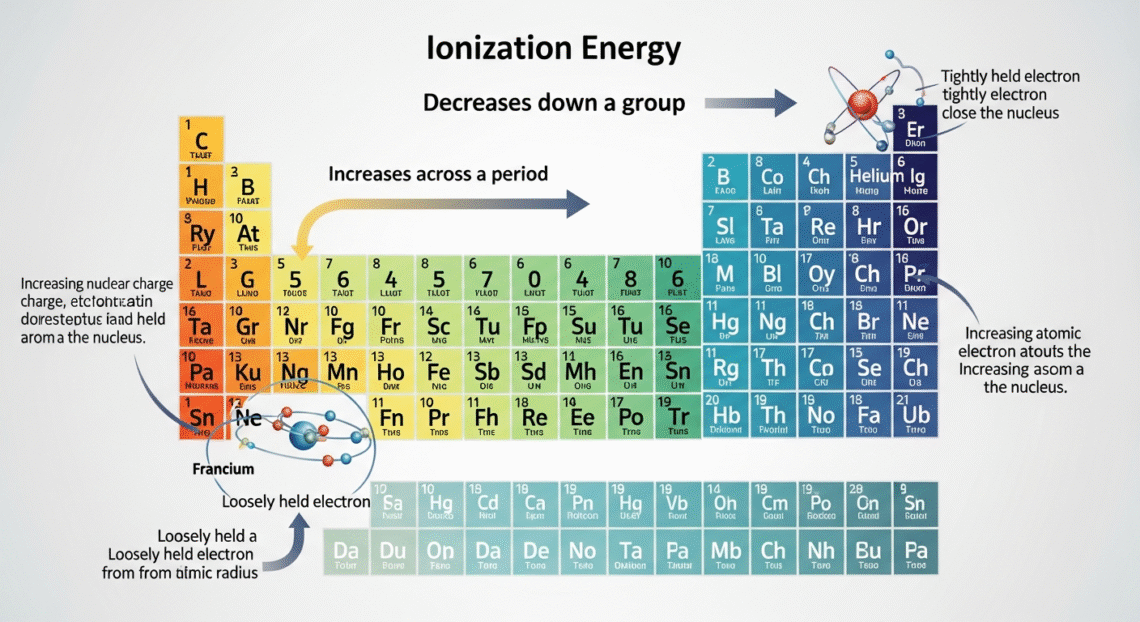
ionization energy trend is very important to know because it tells us how much energy an atom needs to remove one of its electrons. Ionization energy trend helps us understand the behavior of elements in the periodic table. When we look at elements in the same row or column, we can see patterns in how easily they lose electrons. These patterns help scientists and students predict chemical reactions and understand why some elements are more reactive than others. For example, metals usually have lower ionization energy, which means they lose electrons easily, while nonmetals have higher ionization energy because they hold onto their electrons tightly. This trend is very useful in chemistry, from learning basic concepts in school to advanced research in laboratories.
The ionization energy trend also explains why certain elements form positive ions and how they interact with other atoms to make compounds. By studying this trend, we can also understand the stability of atoms, why some elements are more likely to react, and how the size of the atom affects the energy needed to remove electrons. Across a period, the ionization energy generally increases because atoms have more protons, which pull the electrons closer, making them harder to remove. Down a group, the ionization energy decreases because atoms have more electron shells, which place the outer electrons farther from the nucleus, making them easier to remove. The trend is not always smooth because some elements have exceptions due to electron configuration, like nitrogen and oxygen
How Ionization Energy Trend Changes Across Periods
As we move from left to right in a period, the ionization energy trend increases. This happens because the number of protons increases while electrons are added to the same shell. More protons mean stronger attraction to electrons, so it takes more energy to remove an electron. For example, lithium has low ionization energy, while neon has very high ionization energy. This trend explains why metals on the left side of the periodic table lose electrons easily to form positive ions. Nonmetals on the right side rarely lose electrons because removing an electron requires a lot of energy. Students can easily see this trend on the periodic table, helping them understand why reactivity changes across a period.
How Ionization Energy Trend Changes Down a Group
When we move down a group, the ionization energy trend decreases. This is because new electron shells are added, which increases the distance between the nucleus and the outermost electrons. The outer electrons feel weaker attraction from the nucleus, so they can be removed more easily. For instance, sodium has lower ionization energy than lithium, and potassium has lower ionization energy than sodium. This is why alkali metals like potassium and sodium are very reactive. Understanding this trend helps students predict the chemical behavior of elements in the same group. It also explains why heavier metals are more reactive than lighter metals in the same group.
Factors Affecting Ionization Energy Trend
Several factors influence the ionization energy trend. First, the nuclear charge is important. More protons in the nucleus pull electrons closer, increasing ionization energy. Second, atomic size matters. Bigger atoms have outer electrons farther from the nucleus, lowering ionization energy. Third, electron shielding affects the trend. Inner electrons shield outer electrons from the nucleus, making them easier to remove. Fourth, electron configuration can create exceptions to the trend. For example, oxygen has slightly lower ionization energy than nitrogen due to repulsion between paired electrons in the same orbital. Understanding these factors helps students explain why some atoms behave differently from what the general trend predicts.
Ionization Energy Trend and Atomic Size
Atomic size is closely related to the ionization energy trend. Smaller atoms usually have higher ionization energy because their electrons are closer to the nucleus. Larger atoms have lower ionization energy because their outer electrons are farther away. For example, fluorine is small and has high ionization energy, while cesium is large and has very low ionization energy. This connection helps students see that trends in the periodic table are not isolated facts but are linked to multiple properties of atoms. By studying atomic size and ionization energy trend together, learners can predict which elements will react quickly or slowly in chemical reactions.
Exceptions to the Ionization Energy Trend
Although the general ionization energy trend is easy to understand, there are some exceptions. For instance, oxygen has lower ionization energy than nitrogen because of electron repulsion in its orbitals. Similarly, sulfur has lower ionization energy than phosphorus for the same reason. These exceptions occur because paired electrons in an orbital repel each other, making it slightly easier to remove one electron. Teaching students about these exceptions is important because it shows that chemistry has rules but also has small variations. Understanding exceptions also helps in predicting chemical behavior more accurately.
Ionization Energy Trend and Reactivity
The ionization energy trend is directly connected to an element’s reactivity. Metals with low ionization energy, like sodium and potassium, are very reactive because they lose electrons easily. Nonmetals with high ionization energy, like fluorine and oxygen, are also reactive but in a different way—they attract electrons to complete their outer shells. Elements with very high ionization energy, like noble gases, are almost completely nonreactive because they hold onto their electrons tightly. By understanding the ionization energy trend, students can predict how elements will behave in chemical reactions without memorizing every single reaction.
Ionization Energy Trend and Electronegativity
Ionization energy trend also connects with electronegativity, which measures how strongly an atom attracts electrons in a bond. Atoms with high ionization energy often have high electronegativity because they hold their electrons tightly and attract more electrons from other atoms. For example, fluorine has both high ionization energy and high electronegativity, which makes it very reactive. On the other hand, alkali metals have low ionization energy and low electronegativity, making them more likely to lose electrons. Understanding these relationships helps students see the bigger picture of how elements interact in chemical bonding.
Real-Life Applications of Ionization Energy Trend
The ionization energy trend is not just a classroom concept; it has real-life applications. Scientists use ionization energy to understand how atoms behave in chemical reactions, how ions form in solutions, and how elements interact in electronic devices. Batteries and semiconductors rely on the movement of electrons, which is connected to ionization energy. In biology, ionization energy helps explain processes like nerve signaling and enzyme activity. Even in stars, high temperatures remove electrons from atoms, a process influenced by ionization energy. Learning this trend gives students tools to connect classroom chemistry with real-world science.
Conclusion
Understanding the ionization energy trend is key to learning chemistry. It shows how atoms lose electrons, how reactivity changes across periods and groups, and why exceptions occur. The trend also connects with other properties like atomic size, electronegativity, and chemical bonding. By studying ionization energy trend, students can predict chemical reactions, understand element behavior, and see the patterns that make chemistry logical and fun.
FAQs
What is ionization energy trend?
Ionization energy trend shows how much energy is needed to remove an electron from an atom and how this energy changes across the periodic table.
Why does ionization energy increase across a period?
Ionization energy increases across a period because atoms have more protons, pulling electrons closer and making them harder to remove.
Why does ionization energy decrease down a group?
Ionization energy decreases down a group because outer electrons are farther from the nucleus and easier to remove.
| Read also | 5 Hour Energy: The Little Drink That Gives You Big Power |